


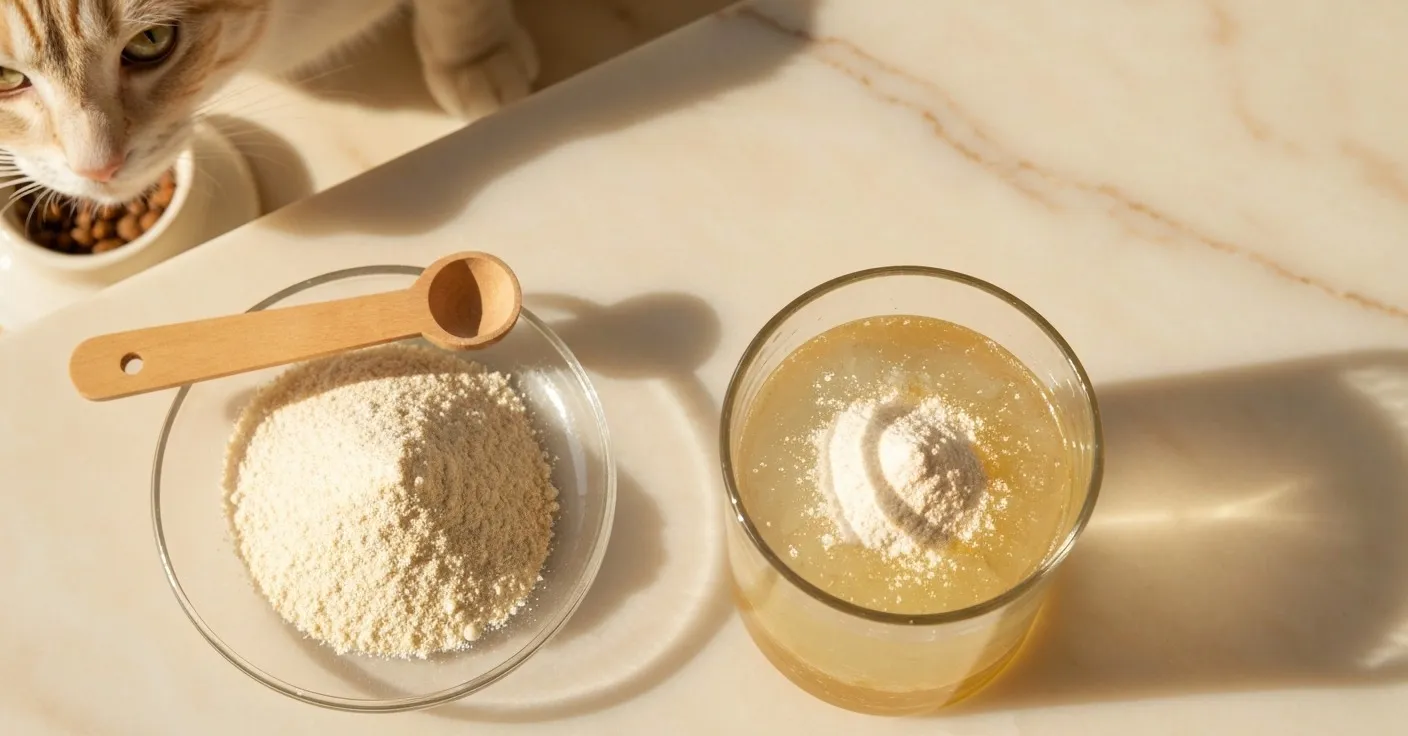
Marcus, a six-year-old Persian, had been retching up hairballs roughly twice a week for as long as his owner could remember. She’d tried everything in the usual hairball repertoire: the petroleum-based gels in the squeeze tubes, a “hairball formula” kibble that seemed to make no difference, and meticulous daily brushing that left her with enough fur to build a second cat. The frequency didn’t change. When she came in, she was expecting a medication or a prescription diet. What she got was a conversation about gut transit time — and psyllium seed husk.
The connection isn’t obvious until you understand what actually happens to swallowed fur. Cats don’t have the enzymatic machinery to digest keratin. Hair enters the GI tract, moves through, and either passes in stool or accumulates in the stomach where it forms a trichobezoar. The question of which outcome occurs depends heavily on GI motility: how fast and effectively the gut moves ingesta along. Psyllium doesn’t groom the cat better. It changes the conditions inside the GI tract in a way that makes transit easier and accumulation less likely.
What psyllium seed husk actually is
Psyllium comes from Plantago ovata, a plant native to western India and widely cultivated today for pharmaceutical and supplement use. The part that matters is the seed husk — the outer fibrous shell of the seed — not the seed itself. This distinction is more important than it sounds. The seed interior is comparatively low in mucilaginous fiber. The husk is where the concentrated soluble fiber lives, sometimes reaching 70–80% of its dry weight in fiber content.
When manufacturers list “psyllium” on a label, they should mean the husk — but it’s worth confirming. Products using the whole ground seed are delivering a significantly weaker fiber effect per gram. The husk is the active part, and it’s the husk that earns psyllium its reputation as one of the most efficient soluble fiber sources available.
In cats, fiber isn’t just a filler. It plays active roles in GI health — and psyllium’s particular properties make it unusually well-suited to the feline digestive environment.
How soluble fiber differs from insoluble fiber
Not all dietary fiber behaves the same way inside the gut, and the distinction matters for understanding what psyllium does.
Insoluble fiber doesn’t dissolve in water. It passes through the GI tract largely intact, adding mechanical bulk to stool and speeding colonic transit by stimulating the gut wall. Wheat bran is a classic example. Insoluble fiber helps with constipation, but it doesn’t form a gel and it doesn’t lubricate.
Soluble fiber dissolves — or more accurately, hydrates — in water to form a viscous gel. Pectin, beta-glucan, and psyllium are all primarily soluble fibers. They slow gastric emptying, create a gel matrix in the small intestine that modulates nutrient absorption rates, and ultimately reach the colon where they’re available for fermentation by the resident microbiome.
Psyllium is predominantly soluble. That gel is precisely what makes it useful in hairball management and stool consistency support. Bulk alone isn’t the mechanism here. Lubrication is.
The gel mechanism in cats
When psyllium husk contacts water, it absorbs roughly 10–20 times its own weight in fluid and swells into a mucilaginous gel. In the GI tract, this gel coats the intestinal mucosa and provides a slippery, low-friction surface that facilitates the movement of ingesta — including swallowed fur — through the digestive system.
Swallowed hair that might otherwise aggregate and remain in the stomach has a mechanically easier journey through a gut that’s been conditioned with soluble fiber. It doesn’t eliminate hair ingestion — grooming behavior is unchanged — but it shifts the outcome distribution. More hair passes through in stool; less accumulates in the stomach long enough to form a bezoar.
This mechanism doesn’t require large doses to be functional. Small amounts of psyllium, added consistently to wet food, can maintain that low-friction intestinal environment day to day (Fahey et al., 1992). Consistency matters more than quantity.
Gut motility connection
Beyond lubrication, psyllium’s effects on gut motility run through the colonic microbiome. Psyllium reaches the large intestine partially intact — it isn’t fully digested in the small intestine — where it’s available for fermentation by resident bacteria. That fermentation produces short-chain fatty acids (SCFAs), particularly butyrate.
Butyrate is the primary energy substrate for colonocytes — the cells lining the colon — and it has a well-characterized stimulatory effect on colonic peristalsis. Higher butyrate concentrations in the colonic environment are associated with more regular, stronger muscular contractions that propel ingesta toward elimination (Topping & Clifton, 2001). For cats prone to slow transit — which underlies both constipation and hairball accumulation — this secondary fermentative effect adds a meaningful layer to psyllium’s mechanism.
It’s not dramatic. This isn’t a laxative effect. It’s a gentle, ongoing support of the motility patterns that keep GI transit regular.
Prebiotic effect
The fermentation that produces SCFAs also feeds specific bacterial populations. Psyllium is partially fermentable, which means it functions as a prebiotic — a substrate that selectively supports beneficial bacteria (Barry et al., 2010). Lactobacillus and Bifidobacterium species, which produce butyrate and other beneficial fermentation products, use psyllium’s mucilage as a carbon source.
Psyllium isn’t as potently prebiotic as inulin or fructooligosaccharides (FOS), which are more rapidly and completely fermented. Its moderate fermentability is arguably an advantage in cats: highly fermentable fibers can cause significant gas and GI discomfort at low doses, while psyllium’s slower fermentation profile makes it gentler on the feline gut. You get prebiotic benefit without the bloating that can accompany more aggressive fiber supplements.
Stool consistency normalization
One of psyllium’s most practically useful properties is that it works bidirectionally on stool consistency — it doesn’t just address one end of the spectrum.
In diarrhea, the gel-forming property absorbs excess fluid in the colon, adding structure to loose stool and slowing transit enough to allow more water reabsorption. In constipation, the same gel adds moisture and lubrication to dry, compacted stool, making passage easier. This bidirectional effect is why psyllium appears in both “stool firming” and “hairball laxative” contexts — it’s normalizing stool consistency toward a middle ground, not pushing in one direction (German, 2009).
For cats with intermittently variable stool consistency — common in indoor cats on dry food diets — this gentle normalization is useful. It doesn’t force the gut to perform; it creates conditions in which it can perform better.
Why it pairs well with probiotics
Psyllium and probiotics address complementary aspects of the GI environment, and combining them is more effective than either alone.
Psyllium provides the prebiotic substrate — the fibrous material that fermentable bacteria use as food. Probiotics provide the bacterial populations that most efficiently ferment that substrate into beneficial SCFAs. When both are present, the probiotic bacteria have more to work with, and the fermentative output — butyrate, propionate, lactate — is greater than what either the resident microbiome alone or the probiotics alone would produce from the same substrate.
In practical terms, this synergy supports a more stable gut environment: more consistent motility, a more colonocyte-friendly fermentation profile, and better substrate availability for the microorganisms doing the maintenance work. It’s why combination products that include both are well-designed when the probiotic strains are chosen thoughtfully. The Petterm Probiotic Hairball Control Powder includes psyllium husk alongside probiotics and digestive enzymes — a formula structure that takes this synergy seriously rather than treating fiber as a passive filler.
Practical considerations
Cats don’t require large amounts of psyllium for functional benefit. The typical dosing range is 0.5–1 gram per day — far smaller than human supplement doses, which often run 3–5 grams or more. Cats’ GI tracts are shorter and more sensitive than ours, and higher doses can cause loose stool or GI discomfort before you’d see benefit.
Powder form works well for most cats when mixed into wet food. The gel-forming property only activates in the presence of water, so cats eating exclusively dry food will get less benefit from psyllium — and may need additional water intake alongside. A practical approach is to add a small amount of warm water or low-sodium broth to dry food when mixing in psyllium powder, both to activate the mucilage and to help maintain the hydration that feline GI health depends on.
Consistency is the key variable. Psyllium’s effects on gut transit, microbiome populations, and stool quality are cumulative — they build over days to weeks of regular use. Giving it occasionally doesn’t establish the conditions that make it useful. Daily inclusion in meals is the intended usage pattern for a supplement like this.

For reference on the probiotic side of the equation, see our deep-dive on probiotics for cats, and for more on the hairball mechanism that psyllium addresses, the guide on hairball causes and prevention covers the full picture.
What psyllium won’t do
Clear limits matter here. Psyllium isn’t a medication and it doesn’t address pathological GI conditions.
An established trichobezoar — a hairball that has already formed into a firm mass — won’t be dissolved or expelled by psyllium supplementation. If a cat is showing repeated, unproductive retching, gagging without producing a hairball, lethargy, or reduced appetite, that’s a veterinary situation. An obstructing trichobezoar requires clinical intervention, not dietary fiber.
Psyllium won’t resolve inflammatory bowel disease, which is a distinct immunological condition requiring diagnosis and prescription management. It won’t address GI motility disorders caused by structural abnormalities, neuropathy, or medication side effects. And it won’t compensate for severely inadequate hydration — cats eating only dry kibble who aren’t drinking enough water may find that psyllium actually worsens constipation if the additional fiber absorbs available gut moisture without enough incoming fluid to compensate.
Supplements work within the range of normal function. They support the conditions for health; they don’t repair pathology.
Frequently asked questions
Is psyllium seed husk safe for cats? At appropriate doses (0.5–1 g/day), psyllium is generally well-tolerated in cats. It’s a natural fiber without significant drug interactions or toxicity risk at typical supplemental doses. If your cat has a diagnosed GI condition or takes any medication, check with your veterinarian first — particularly for cats on blood sugar medications, since high-dose soluble fiber can affect glucose absorption timing.
Can I use human psyllium products (like Metamucil) for my cat? Plain, unflavored psyllium husk powder — just psyllium, no additives — can be used. However, many human psyllium products contain sweeteners like aspartame or stevia that shouldn’t be given to cats. Always check the ingredient list. Purpose-formulated cat products are the safer choice because they’re dosed and flavored appropriately.
My cat is already on a “hairball formula” kibble. Does psyllium add anything? Hairball control kibbles typically use insoluble fiber (often cellulose) to add bulk that moves fur through mechanically. Psyllium’s soluble fiber mechanism — gel formation, lubrication, prebiotic effect — is different and potentially complementary. They’re addressing the transit problem through different mechanisms.
How quickly does psyllium work for hairball control? Give it two to four weeks of consistent daily use before assessing whether it’s making a difference. GI environments shift gradually; the microbiome adjusts over weeks, not days. Counting hairball episodes over a month-long trial gives you a more reliable read than looking for day-to-day changes.
Should I be concerned about psyllium causing a blockage? At appropriate doses and with adequate water intake, psyllium doesn’t cause blockages in otherwise healthy cats. The gel it forms is slippery and pliable, not solid. The concern would arise only if a cat ate an extremely large amount of dry psyllium without any water — which isn’t how supplements are administered. Always mix into wet food or add water.
Does psyllium interact with medications? Soluble fiber can slow the absorption of some oral medications by trapping them in the gel matrix during transit. As a general rule, administer any medications at least an hour before or after psyllium-containing supplements. Ask your veterinarian if your cat takes any medications that require precise absorption timing.
References
- Topping, D.L. & Clifton, P.M. (2001). Short-chain fatty acids and human colonic function: roles of resistant starch and nonstarch polysaccharides. Physiological Reviews, 81(3), 1031–1064.
- Leib, M.S. (2000). Treatment of chronic idiopathic large-bowel diarrhea in dogs with a highly digestible diet and soluble fiber: a randomized controlled clinical trial. J Vet Intern Med, 14(1), 27–33.
- German, A.J. (2009). Diet and the gut. Vet Clin North Am Small Anim Pract, 39(2), 259–273.
- Fahey, G.C., et al. (1992). Dietary fiber for companion animals. J Anim Sci, 70(9), 2716–2731.
- Barry, K.A., et al. (2010). Dietary fiber increases fecal fermentation product concentrations and modulates intestinal bacteria in cats. J Anim Sci, 88(8), 2730–2741.
This article is for educational purposes and is not veterinary medical advice. Petterm products are not intended to diagnose, treat, cure, or prevent any disease. Results may vary. Always consult your veterinarian before introducing a new supplement, especially if your cat has an existing digestive condition or takes medication.