


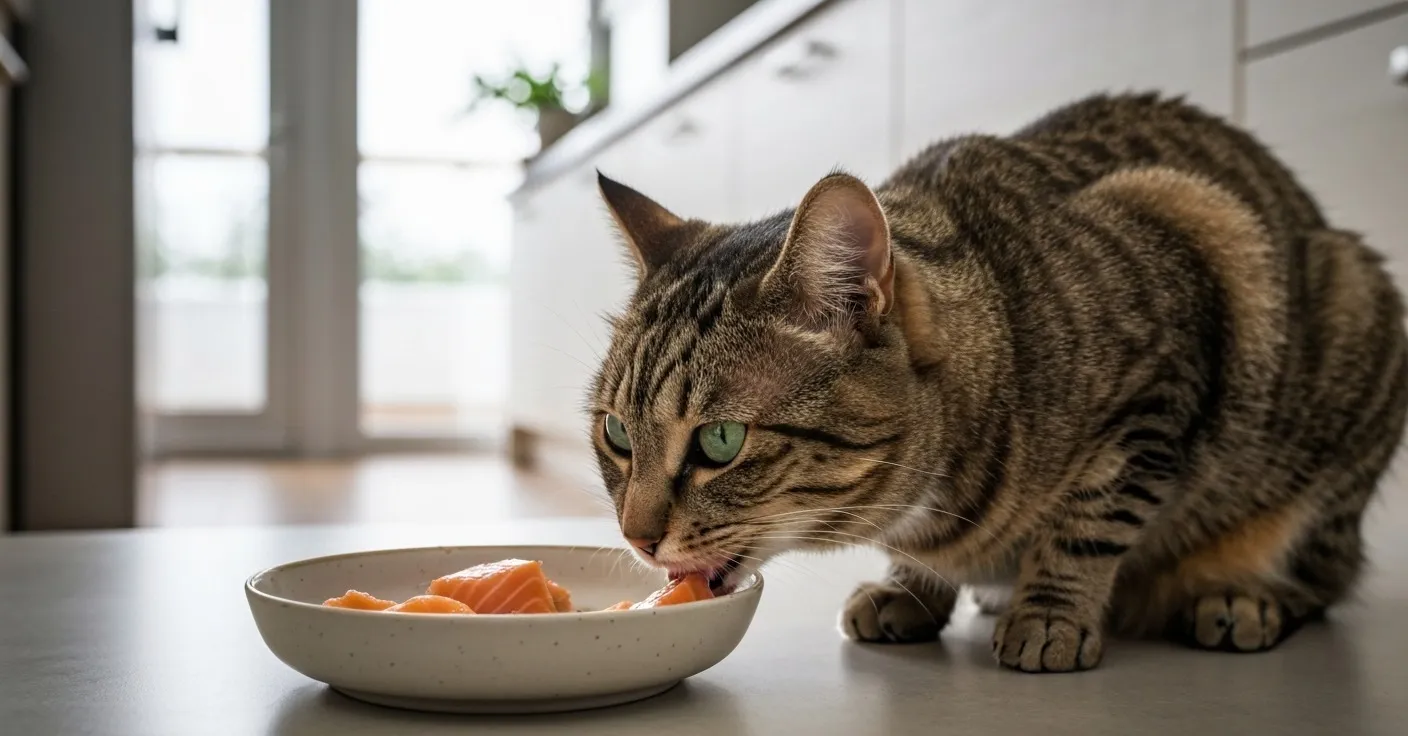
A friend of mine spent the better part of a year running an unintentional feeding experiment on her two indoor cats, Fern and Douglas. Both were otherwise healthy — annual vet checks, normal bloodwork, no parasites — but they’d had recurrent soft stools for months. Not diarrhea, exactly. Just never quite right. She went through five different premium wet foods methodically, rotating every six to eight weeks, logging everything. Chicken formula: soft stools. Salmon formula: soft stools. Limited ingredient turkey: mild improvement, then back to soft stools.
When she finally brought the full list to her vet, it took about three minutes to spot the pattern. Every food she’d tried contained carrageenan as a thickening agent. The protein source wasn’t the problem at all. One switch to a carrageenan-free formula, and both cats normalized within two weeks.
The lesson wasn’t that carrageenan is universally harmful — it isn’t, for all cats. The lesson was that wet food labels are designed to sell product, not to make ingredient evaluation easy. And for indoor cats especially, the details matter more than the branding.
Why indoor cats have different nutritional needs
An indoor cat’s daily life looks nothing like a wild felid’s. No hunting, no territory patrol, no irregular feeding schedules driven by prey availability. What it does look like, for most indoor cats, is a lot of resting, intermittent boredom, occasional bursts of play, and a feeding bowl that appears reliably twice a day.
That lifestyle changes their nutritional math. Caloric expenditure is lower than in outdoor cats — sometimes significantly lower — which means a food that’s appropriate in caloric density for an active outdoor cat can quietly tip an indoor cat toward overweight over months. Stress physiology is also different. Indoor cats often experience chronic low-level stress from environmental monotony, multi-pet household dynamics, or insufficient enrichment, which affects gut motility and immune function in ways that nutritional choices can either support or worsen.
There’s also the hairball factor. Indoor cats groom more than their outdoor counterparts, partly from habit and partly from boredom. More grooming means more ingested fur. Without appropriate fiber and moisture in the diet, that fur doesn’t move efficiently through the digestive tract (Laflamme et al., 2011). Wet food’s moisture content is a first-line tool for managing that risk — something we’ll come back to.
The case for wet food over dry
Cats have a low thirst drive. This isn’t a behavioral quirk. It’s an evolutionary artifact from desert-adapted ancestors who met nearly all their moisture needs through prey tissue, not standing water (Zoran, 2002). Domesticated cats retain this physiology regardless of whether they live in a Tucson backyard or a Chicago apartment.
Dry food contains roughly 6–10% moisture. Wet food contains 75–82%. A cat eating exclusively dry food is, from a hydration standpoint, operating in a mild chronic deficit that their body manages — right up until it becomes a urinary tract problem, kidney stress, or constipation. Kirk (2011) demonstrated that increasing dietary water intake through wet food significantly raises urine output and dilutes urine specific gravity, both of which reduce the risk of crystal formation and support long-term urinary tract health.
This doesn’t mean dry food is always wrong for every cat. It means that for indoor cats with lower activity levels and higher hairball risk, the hydration advantage of wet food compounds over time in meaningful ways. If your cat currently eats exclusively dry food, a partial wet food transition is worth discussing with your vet.
What to look for on the label
Protein first — the right kind
The first ingredient should be a named animal protein: chicken, turkey, salmon, beef, duck, rabbit. Not “poultry,” not “fish,” and not “meat by-products” as the primary protein source. Named ingredients indicate a specific source, which matters for both digestibility and for identifying what to change if your cat develops a sensitivity.
Cats are obligate carnivores. Their metabolic wiring requires animal protein not as a preference but as a physiological necessity — they can’t synthesize taurine, arachidonic acid, or vitamin A from plant precursors the way dogs and humans can (Zoran, 2002). A food that leads with a plant protein or uses “meat by-products” as the anchor protein is working against your cat’s basic biology.
By-products aren’t inherently harmful — organ meats are nutrient-dense and appropriate. The issue is using them as the primary named protein while keeping the actual meat content low.
Moisture content: the 78–82% target
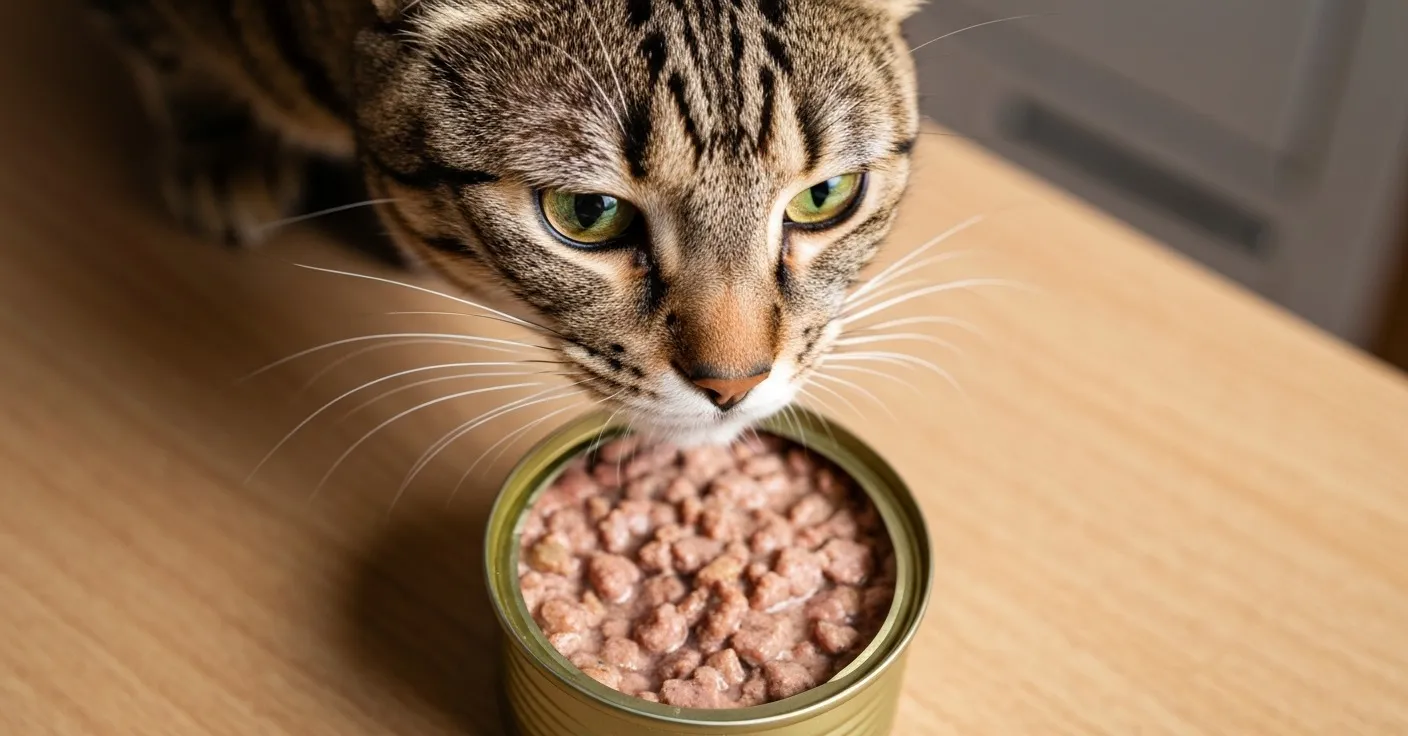
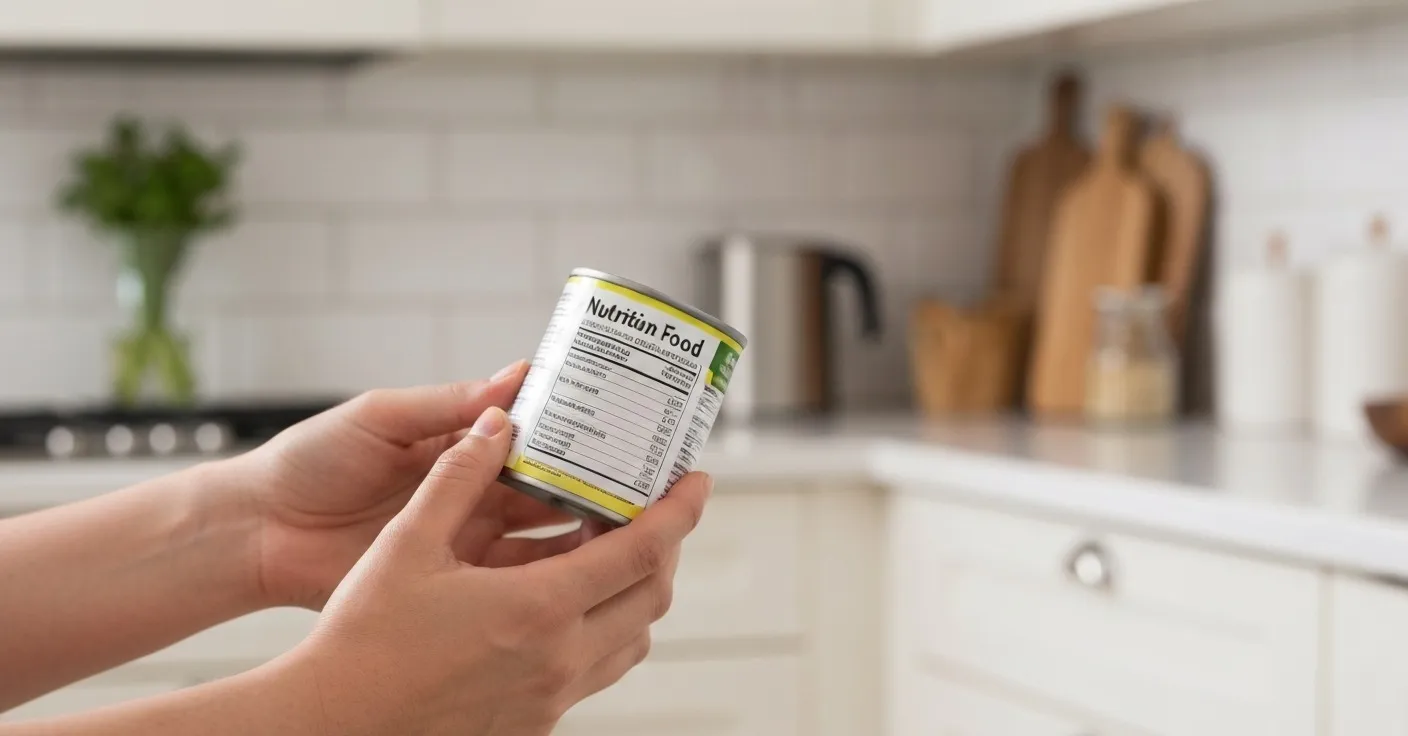
Check the guaranteed analysis panel on the can. “Moisture” should read 78–82% for a true wet food. Anything below 70% is closer to a “moist” or “semi-moist” product, which is a different nutritional category. Products marketed as “wet food” in pouches sometimes land in the 70–75% range — check the label rather than assuming.
Fat-to-protein ratio
Indoor cats don’t need high-fat formulas. Moderate dietary fat — roughly 4–8% on a dry matter basis — is appropriate. High-fat formulas, particularly those marketed for “active” cats or “working breeds,” can contribute to weight gain in cats whose caloric expenditure doesn’t match the energy density.
To compare formulas accurately, convert to dry matter basis by dividing the as-fed percentage by (100 minus the moisture percentage). It’s a bit of math, but it’s the only way to compare a wet food against another wet food fairly.
Minimal thickeners — and which ones matter
Most wet cat foods use gelling or thickening agents to achieve their texture. Not all of these are equal. Carrageenan — derived from red seaweed — has been the subject of ongoing concern in both human and animal nutrition literature, with some studies suggesting it may contribute to intestinal inflammation in sensitive individuals. The evidence isn’t settled, and many cats tolerate it without visible issue. But if your cat has ongoing digestive instability, it’s a reasonable variable to eliminate.
Guar gum and locust bean gum are the most commonly cited alternatives. Both are well-tolerated in the quantities used in cat food and don’t carry the same concerns as carrageenan in the current literature. Agar-agar is another option you’ll see in grain-free or limited-ingredient formulas.
What to skip
Grain confusion
Grains have been marketed as the enemy of cat health for roughly two decades, largely on the back of the “obligate carnivore” argument. The reality is more nuanced. Grains aren’t inherently inappropriate for cats — the issue is digestibility and proportion. Verbrugghe & Hesta (2017) reviewed the evidence on cats and carbohydrates and concluded that while cats have limited amylase activity compared to omnivores, they can utilize moderate amounts of digestible carbohydrates without harm.
The real problem isn’t rice or oatmeal in a food — it’s wheat gluten used as a protein booster. Wheat gluten is a cheap way to elevate the protein percentage on a label without adding actual meat. It doesn’t deliver the amino acid profile that cats need. If you see “wheat gluten” appearing in the first five ingredients, look elsewhere.
”Indoor formula” marketing
This one isn’t a scam, exactly. It’s more of a mixed bag. “Indoor formula” typically means the food has added fiber (often psyllium, beet pulp, or cellulose) to support hairball transit, and sometimes a slightly reduced caloric density. Both can be useful features. But they’re not magic — and they’re not a substitute for the protein quality, moisture content, and ingredient integrity that matter more.
Don’t pay a premium for “indoor” labeling if the underlying formula doesn’t hold up on the criteria that actually matter. A non-indoor-labeled food with excellent protein quality, 80% moisture, and no carrageenan will serve your cat better than an “indoor formula” with mediocre protein and marketing-driven fiber.
Artificial preservatives and colorings
BHA, BHT, and propyl gallate are antioxidant preservatives used primarily in dry foods to prevent fat oxidation. They’re largely unnecessary in wet food, which is shelf-stable in its sealed state without them. Their presence in a wet food is a flag worth noting — it may indicate a manufacturer cutting corners on formulation or using lower-quality fat sources that require more aggressive preservation.
Artificial colorings serve no nutritional purpose whatsoever. Cats don’t choose food by color. If a food contains red dye or caramel color, it’s there for the human buyer’s benefit, not the cat’s health.
The hydration equation
Here’s a concrete way to think about moisture requirements. A healthy 10-pound indoor cat needs roughly 200–250 mL of water per day from all sources combined — food and drinking water. A cat eating exclusively dry food (10% moisture) gets about 20–25 mL of that from food. The rest has to come from the water bowl, and most cats don’t drink enough voluntarily to fully compensate.
A cat eating wet food at 80% moisture gets approximately 160–180 mL per day from food alone, leaving a small and manageable gap to fill from drinking. The difference isn’t marginal — it’s the difference between a cat running at adequate hydration and one that’s chronically mildly underhydrated, with all the downstream consequences for kidney function and urinary tract health that entails (Buckley et al., 2011).
Wet food doesn’t eliminate the need for fresh water. Keep the bowl clean and accessible. Some cats prefer running water — a fountain-style bowl can significantly increase voluntary intake. But wet food as the foundation dramatically shifts the baseline.
Rotation feeding
Most cat owners find a food their cat accepts and stick with it indefinitely. That’s understandable. Cats are creatures of habit, and food transitions are genuinely stressful for many of them. But feeding the same formula for years can contribute to two problems that are worth being aware of.
First, it can create a preference so strong that switching — when you need to, for health reasons or supply issues — becomes a significant project. Cats that have eaten only one food for years sometimes refuse anything else, which is a real problem if their health requires a dietary change.
Second, repeated long-term exposure to a single protein source may contribute to sensitivity development in some cats. The mechanism isn’t fully understood, but clinicians regularly see cats who’ve eaten chicken-based food exclusively for years develop loose stools or itching that resolves when the protein is rotated. This isn’t universal — plenty of cats eat the same food for their whole lives without issue. But rotating between two or three compatible formulas every few months is a reasonable precaution.
Rotate slowly. Mix 25% new food with 75% old for three to four days, then 50/50 for three to four days, then 75% new. Rushing this causes exactly the GI upset you’re trying to avoid.
When to pair wet food with supplementation
Wet food provides the moisture foundation, but it doesn’t address every aspect of indoor cat digestive health. Cats that are heavy groomers, those in multi-cat households with elevated stress, and cats prone to intermittent soft stools often benefit from digestive support alongside a quality wet food routine.
This is where products like Petterm Probiotic Hairball Control Powder can play a useful supporting role. Designed to be mixed into any wet food, it combines probiotic strains that help maintain gut microbiome balance with fiber that supports hairball transit — addressing two of the most common indoor cat digestive challenges simultaneously. It’s a complement to good nutrition, not a substitute for it.
For more on the gut health angle, see our article on probiotics for cats and how nutrient absorption connects to microbiome balance. If hairball management is a specific concern for your indoor cat, we’ve also covered hairball causes and prevention in depth.
Red flags that a food isn’t working
Switching foods is a data-gathering process. Give a new food four to six weeks before deciding — short-term digestive adjustment is normal. But these signs suggest a food isn’t a good fit and warrants a change:
Persistent soft stools beyond two weeks. Some loosening during transition is expected. Soft stools that don’t resolve suggest the formula isn’t agreeing with your cat’s gut.
Coat deterioration. A dull, dry, or flaky coat that develops after a food change is often a sign of inadequate essential fatty acid content or poor protein digestibility. A good wet food should support coat quality, not compromise it.
Weight creep. If your cat gains weight on a formula despite consistent portions, the caloric density may be too high for their activity level. This is common with high-fat formulas fed to sedentary indoor cats.
Increased vomiting frequency. Occasional vomiting is normal for cats. A significant increase in frequency after introducing a new food — especially vomiting of undigested food, not hairballs — is worth investigating. Try eliminating one variable at a time (thickener, protein source) before concluding the format doesn’t work.
Frequently asked questions
Does wet food cause dental problems in cats? Dry food’s reputation as a dental health tool is mostly marketing. Studies don’t consistently show that dry food prevents tartar accumulation meaningfully — and the mechanical action of most kibble doesn’t contact the gum line where periodontal disease starts. Dental health is best maintained through regular brushing and professional dental cleanings, regardless of food type.
How much wet food does a 10-pound indoor cat need per day? Most 10-pound cats need roughly 200–250 calories per day. Check the caloric density of the specific food (calories per can or pouch) and calculate accordingly. Adjust based on your individual cat’s weight trend over four to six weeks. Cats who gain on a given amount need less; cats who lose need more.
Is it okay to mix wet and dry food? Yes, and for many cats it’s a practical compromise. Wet food in the morning and evening provides the hydration benefit; a small amount of dry food midday can provide enrichment (puzzle feeders, scatter feeding) that wet food doesn’t easily support. Just account for the total caloric contribution of both.
My cat won’t eat wet food at all. What should I do? Some cats, especially those raised exclusively on dry food, need a very gradual introduction. Start by adding a small amount of the wet food alongside their dry food without mixing. Progress to mixing. Warming the wet food slightly can increase palatability for reluctant cats. It often takes two to three weeks to see acceptance.
Are grain-free wet foods actually better for cats? Not inherently. Grain-free formulas sometimes substitute legumes (peas, lentils) for grains, which can create their own digestibility questions. Evaluate the food on protein quality, moisture, and ingredient integrity — not just whether it has a “grain-free” banner.
How should I store open wet food? Refrigerate opened cans immediately and use within two to three days. Use a can cover or transfer to an airtight container. Bring refrigerated food to room temperature before feeding — cats are less likely to accept cold food, and it’s easier on the digestive system.
Can kittens eat the same wet food as adult indoor cats? No. Kittens have significantly higher protein, fat, and caloric needs than adults. Look for food labeled “complete and balanced for all life stages” or specifically for kittens until your cat is twelve months old.
Is it normal for cats to be pickier as they age? Yes. Older cats may have reduced smell sensitivity, dental discomfort, or changing preferences that make them more selective. Warming food, trying different textures (pâté vs. shredded), and checking for underlying health issues are the right steps before concluding a senior cat is simply being difficult.
When to contact your veterinarian
This is a nutrition guide, not a medical treatment plan. The framework here applies to healthy adult indoor cats.
Schedule a consultation if: your cat has chronic kidney disease (protein restriction or modification may be clinically indicated), hyperthyroidism (caloric needs are substantially altered), diabetes (carbohydrate management becomes critical), or if any dietary change causes GI upset that persists beyond two weeks. These conditions require individualized dietary guidance that goes beyond general label-reading principles.
Seek same-day care if: your cat vomits blood, loses appetite completely for more than 24 hours, develops sudden severe diarrhea with blood or mucus, or shows signs of a possible obstruction (retching without producing vomit, visible abdominal distension, extreme lethargy). These are emergencies regardless of what they ate.
A good wet food can do a lot for your indoor cat’s long-term health. It can’t replace veterinary care when something is genuinely wrong.
References
- Zoran, D.L. (2002). The carnivore connection to nutrition in cats. J Am Vet Med Assoc, 221(11), 1559–1567.
- Kirk, C.A. (2011). New concepts in feline patient hydration. J Feline Med Surg, 13(4), 240–246.
- Verbrugghe, A. & Hesta, M. (2017). Cats and carbohydrates: the carnivore fantasy? Vet Sci, 4(4), 55.
- Laflamme, D.P., et al. (2011). Pet feeding practices of dog and cat owners in the United States and Australia. J Am Vet Med Assoc, 232(5), 687–694.
- Buckley, C.M., et al. (2011). Effect of dietary water intake on urinary output, urine specific gravity and urinary relative supersaturation for calcium oxalate. Br J Nutr, 106(S1), S128–S130.
This article is for educational purposes and is not veterinary medical advice. Petterm products are not intended to diagnose, treat, cure, or prevent any disease. Results may vary. Always consult your veterinarian before making significant dietary changes, especially if your cat has an existing health condition.